What it can do
A complete desktop, not a demo.
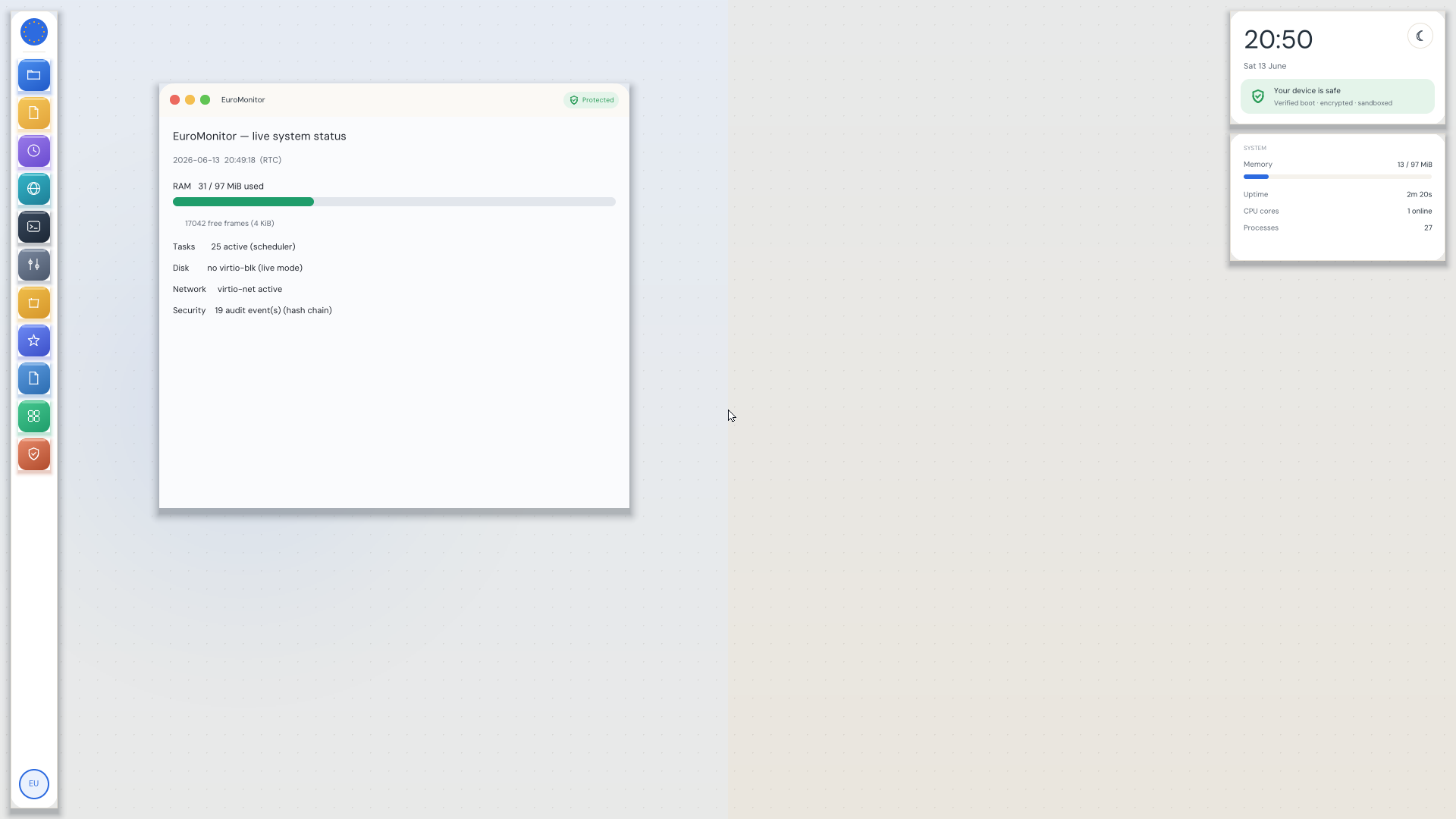
EuroOS isn't a kernel proof-of-concept. It's an office suite, AI agents, 24 European languages, storage that reads the disks and shares you already have, its own trust stack and a developer toolchain, every layer written from scratch in Rust, and tested against the real formats, tools and hardware it has to work with.
Office suite
EuroSuite, Writer, Calc & Impress on one document model. Opens and saves Word/Excel/PowerPoint (OOXML) and OpenDocument (ODF), with a real spreadsheet formula engine.
Sovereign AI agents
EuroAgent runs AI agents capability-isolated in the kernel, with a local model by default. They do real work, fully audited, and work completely offline. No mandatory cloud.
24 EU languages
Every official EU language, baked in: number, currency and date formatting, plural rules and correct sorting, plus a multilingual screen reader for accessibility.
Your own trust stack
Run your own certificate authority, prove a machine's state with the on-board TPM, and map people to permissions, no foreign certificate or identity provider required.
Networking & VPN
A from-scratch TCP/IP stack, TLS 1.3 with a European trust store, a stateful firewall and a sovereign forward-secret VPN, the security-critical path is all auditable EuroOS code.
Runs Linux apps
Unmodified musl/Linux programs run as-is through a compatibility bridge, while the sovereign core stays the real surface. Compatibility without surrendering control.
Build & verify
A complete toolchain: signed packages (tampered ones are refused), dependency resolution, and reproducible builds so anyone can prove a binary came from the published source.
Works with your disks
Open a FAT or exFAT drive and save straight to it, browse an ext4 partition, plug in a USB stick, or reach a Windows (SMB) or NFS network share. EuroOS talks to them directly, your files stay on the media you already use.